

In the Bay Area, moving is rarely the answer. With median home prices in Hayward sitting near $870,000, and deeper into San Francisco and Silicon Valley well above that, most homeowners are choosing to stay and improve what they have. Kitchens, bathrooms, living areas, and upper levels are all getting the renovation treatment. And when those renovations include a hard surface floor, the question of what happens in the room below becomes very real.
Concrete and polished hard surfaces are one of the more compelling upgrades you can make to a home. They’re durable, seamless, and low-maintenance in a way that tile and hardwood simply aren’t. In many Bay Area homes, including older Victorians in San Francisco, mid-century flats in Oakland and Berkeley, and newer builds in Fremont and Cupertino, a concrete or microcement finish on an upper level transforms a tired room into something worth keeping.
But concrete is a conductor. Every footstep, dropped object, and scrape puts energy directly into your floor structure, and that energy travels. In a two-story home in San Mateo or a townhome in Alameda, it lands in the room below as noise. That’s impact noise, and it’s a problem that hard surfaces on concrete or wood-framed floors make worse, not better.
Planning for it before the renovation is finished is a lot easier than dealing with it after.
What California Requires
If your home falls under HOA rules, or if you own a multi-family property anywhere in the Bay Area, this matters for your project specifically. The California Building Code (CBC) requires a minimum IIC rating of 50 (Impact Isolation Class) between floor assemblies in multi-family buildings. That’s the statewide floor. Cities across the Bay Area, including San Francisco, Oakland, and San Jose, can and often do set the bar higher.
California HOAs have broad authority to enforce noise nuisance provisions under state law. Courts have required homeowners to add sound-dampening materials to existing hard floors where neighbor complaints were substantiated, meaning a renovation that doesn’t account for impact isolation can create problems well after the project is done. Whether you’re renovating a condo in Emeryville, a townhome in Walnut Creek, or a multi-unit building in the East Bay, the acoustic performance of your floor is a real design requirement, not an afterthought.
A Finish Worth Installing, Built Right from the Base
Most soundproof flooring systems end with tile, LVP, or hardwood. The acoustic problem is addressed, but the floor looks like every other floor.
This system ends with a Skraffino microtopping. That’s a seamless, polished concrete surface with no grout lines, no tile edges, and no visible seams. Color is fully customizable through Colorfast integral pigments, dyes, or stains, so the finished look is completely your own. It’s the kind of surface that concrete countertops and polished showrooms are made of, now available as a residential floor system with real acoustic control underneath.
Duraamen designs the system for you. Whether you’re a homeowner trying to figure out the product stack or a contractor specifying a multi-unit building in the South Bay, Duraamen’s team in Hayward can build a custom specification around your substrate, space, and finish goals. You source the KeedeRoll® MT acoustical membrane at the base. Duraamen handles everything above it.
The System, Layer by Layer
Here’s what a Duraamen soundproof floor looks like from the slab up.
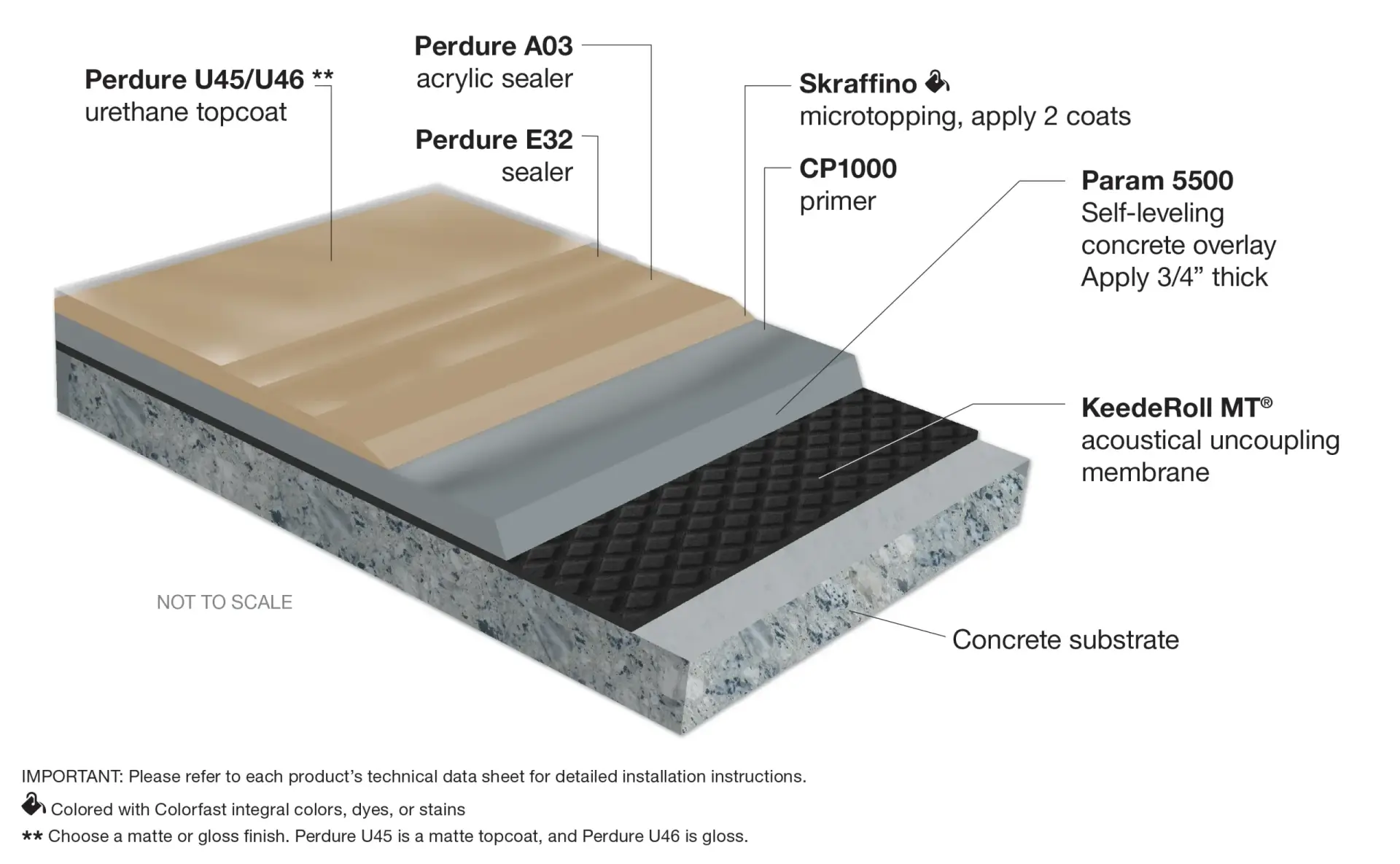
KeedeRoll® MT goes down first, directly over the concrete substrate. KeedeRoll® MT is an acoustical uncoupling membrane (the MT stands for Muffling Technology), and it works by decoupling the finished floor from the slab below. When the two surfaces aren’t in direct contact, vibrations from footsteps can’t travel straight through the structure into the space below. On an 8″ concrete slab, it achieves an IIC rating of 54, which meets California’s code minimum on its own.
Param 5500 goes over the KeedeRoll® MT at 3/4″ thick. This self-leveling concrete overlay creates a flat, stable surface for everything above. The added mass also contributes to sound blocking.
CP1000 primer goes on next, preparing the Param 5500 surface to bond with the microtopping.
Skraffino microtopping goes on in two coats. This is the decorative layer, the part you see and walk on every day. Because it applies thin, it doesn’t raise your floor height the way tile or hardwood would. Colorfast integral pigments, dyes, or stains give you complete control over the final look. The result is a seamless, continuous surface with no grout lines to trap dirt and no tile edges to chip or crack.
Perdure A03 acrylic sealer and Perdure E32 sealer follow the Skraffino, building the protective base before the topcoat.
Perdure U45 or U46 urethane topcoat closes the system. U45 is matte, U46 is gloss. Either way, you get a durable surface that holds up to daily foot traffic and cleans easily.
Where This Fits in the Bay Area
This system works across the full range of Bay Area home types and project scopes:
- Two-story homes throughout Hayward, Fremont, San Jose, Cupertino, and Palo Alto where upper-level hard floors need acoustic separation from the rooms below
- Condos and townhomes in San Francisco, Oakland, Berkeley, Alameda, and along the Peninsula where HOA noise standards and CBC compliance both apply
- Multi-unit properties in the East Bay and South Bay where impact isolation is a specification requirement
- Home theaters, media rooms, and music spaces in residential properties throughout Marin County, Walnut Creek, and Silicon Valley
- Luxury renovations where the floor is meant to be the statement and acoustic performance is part of what makes it worth doing
Duraamen’s Hayward location serves the full Bay Area, including San Francisco, the East Bay, the Peninsula, Silicon Valley, and Marin. If you’re working on a project anywhere in Northern California, the team can put together a specification built around your specific floor.
What You End Up With
A finished Duraamen soundproof floor looks like polished concrete. No grout lines, no tile edges, no visible seams. The color runs consistently across the entire floor and is locked in at installation. The surface resists daily wear, cleans without special products, and comes in matte or gloss depending on which topcoat you choose.
What you don’t end up with is the noise problem that comes with every footstep on a hard floor. The KeedeRoll® MT acoustical membrane handles that at the base of the system, before the Skraffino finish ever enters the picture.
If you’re a Bay Area homeowner renovating an upper level, a property owner managing a multi-unit building, or a contractor specifying a project in Northern California, Duraamen’s Hayward team can build the system around your project.
Duraamen Bay Area Hayward, CA 510-586-0690 Monday–Friday, 9am–5pm